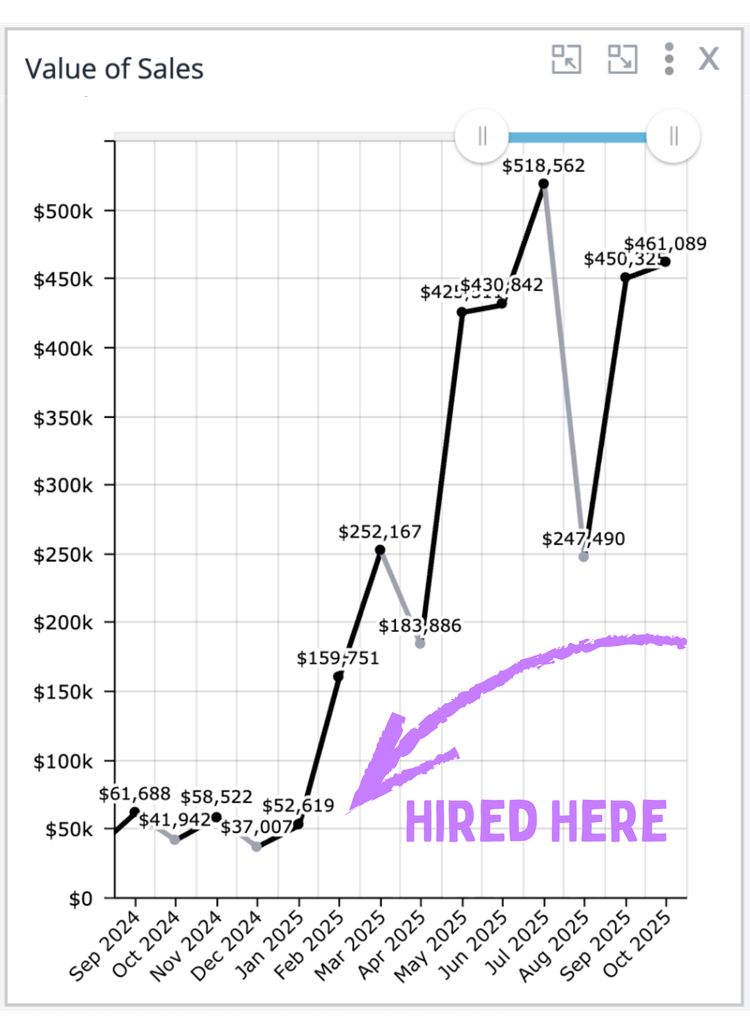
This wasn’t luck… and it took multiple different things to make this happen:
A performance-focused hiring process
Performance dashboards
Clear role definition
Targets and quotas
Accountability-focused management tools
But it all started with a high-performing job ad.
Yep - job ads can make or break EVERY HIRE.
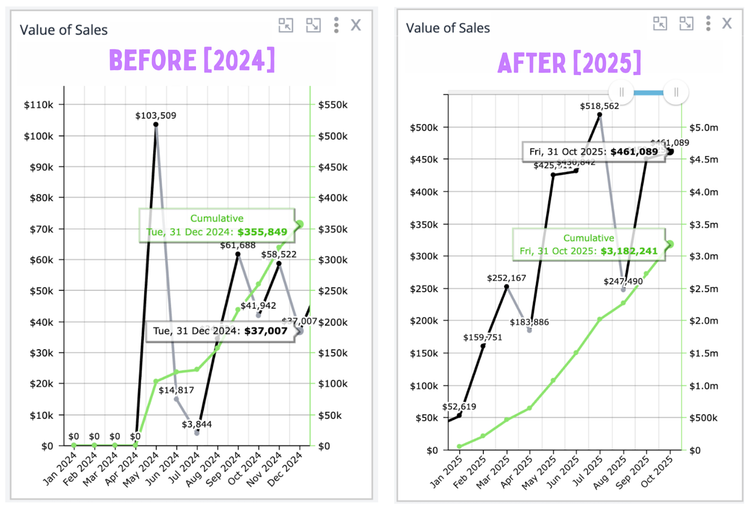
The job ad I wrote for this role attracted the candidate who grew a department from $355k to $3.1m in 12 months:
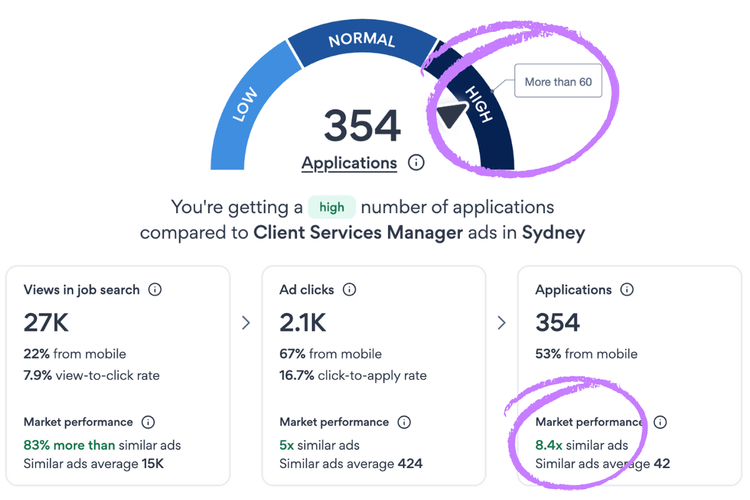
The ad pulled 354 applicants (8.4× higher than similar ads)
No expensive recruiter fees. No poaching.
Just a strategic job ad that compelled the right person to apply.
That one hire 9X’d revenue because the ad didn’t just “describe a role” ..
The ad spoke directly to high-performer psychology,
filtered out low performers,
and positioned the opportunity so the right person felt called to it.
This is what the candidate said about the ad:
“This job ad made me laugh, it's unique and inventive, and it really spoke to me.”
Want to see the exact ad this $3.1m performer applied for?
👉 Drop your email and I’ll send you the full job ad for free.
You attract (and repel) the right people by writing ads that speak to your ideal candidate and make them say: “This is the job I want.”
I have 16 Ad Writing Laws I use to consistently get up to 8× more applicants than similar ads.
Here’s the stats from the real ad I used to hire the guy who made that $3m improvement:
Here are 3 vital tips you can implement in your ads today:
➤ 1. Speak directly TO the person, not about them
Most ads talk about a candidate:
“Looking for an experienced manager…”
This creates distance and feels generic.
Instead, speak to them:
This triggers instant self-identification.
High performers feel seen. Low performers are filtered out.
“You want responsibility, a real challenge, and the freedom to run your area properly…”
➤ 2. Write your ad so the RIGHT person feels excited and the WRONG person feels uncomfortable
Your goal isn’t to please everyone.
Your goal is self-selection.
High performers should think: “This is exactly me.”
Low performers should think: “This sounds too demanding.”
We have even had candidates COMPLAIN because they thought our ads are too intense (that is great and means your ad is working - clearly not the role for them!)
You achieve this be being hyper-specific on stating WHO THEY ARE when you write the ad. Here are some examples:
"Everywhere you have worked, you have quietly taken pressure off your manager, tightened the systems, lifted the standard of people and performance, and left the place calmer, stronger and producing more than when you arrived."
"You are extroverted & friendly and love being in roles where you work closely with an internal team, but also where you’re on the front lines with clients. You’re prompt, diligent and reliable so clients just LOVE dealing with you. "
"You’re always thinking “what can I do to make my team stronger? Happier? More efficient?”. Your staff love you and always perform their best when you’re around."
➤ 3. Make your titles scroll-stopping
Your job ad title determines 80 percent of your click-through rate.
Most titles are boring, vague, or identical to competitors. Better:
“Operations Manager - Right Hand to the Owner”
“Project Manager - Take Ownership of Your Own Portfolio”
“Client Services Lead - Build a Team You’re Proud Of”
Include ANY WORDS that make it stand out “full training provided” “Help a busy founder” “Tough role”
Clickable titles cut through noise and attract the right people fast.
Drop your email below and I’ll send you the exact ad that attracted this powerhouse!
I’ll send you the exact job ad that:
Pulled 354 applications
Outperformed similar ads by 8.4×
Attracted the high performer who delivered $3.1m in revenue
Helped a company scale without increasing the owner’s workload
Because it followed a proven structure that:
Positions the role as meaningful
Speaks directly to high performer psychology
Creates instant ownership and excitement
Filters out low accountability mindset
Makes your company stand out against 100+ competing ads
Makes the RIGHT person want your role over others
This is the difference between 12 mediocre applicants and 354 high-quality ones.
Drop your email below and I’ll send it straight to your inbox.